
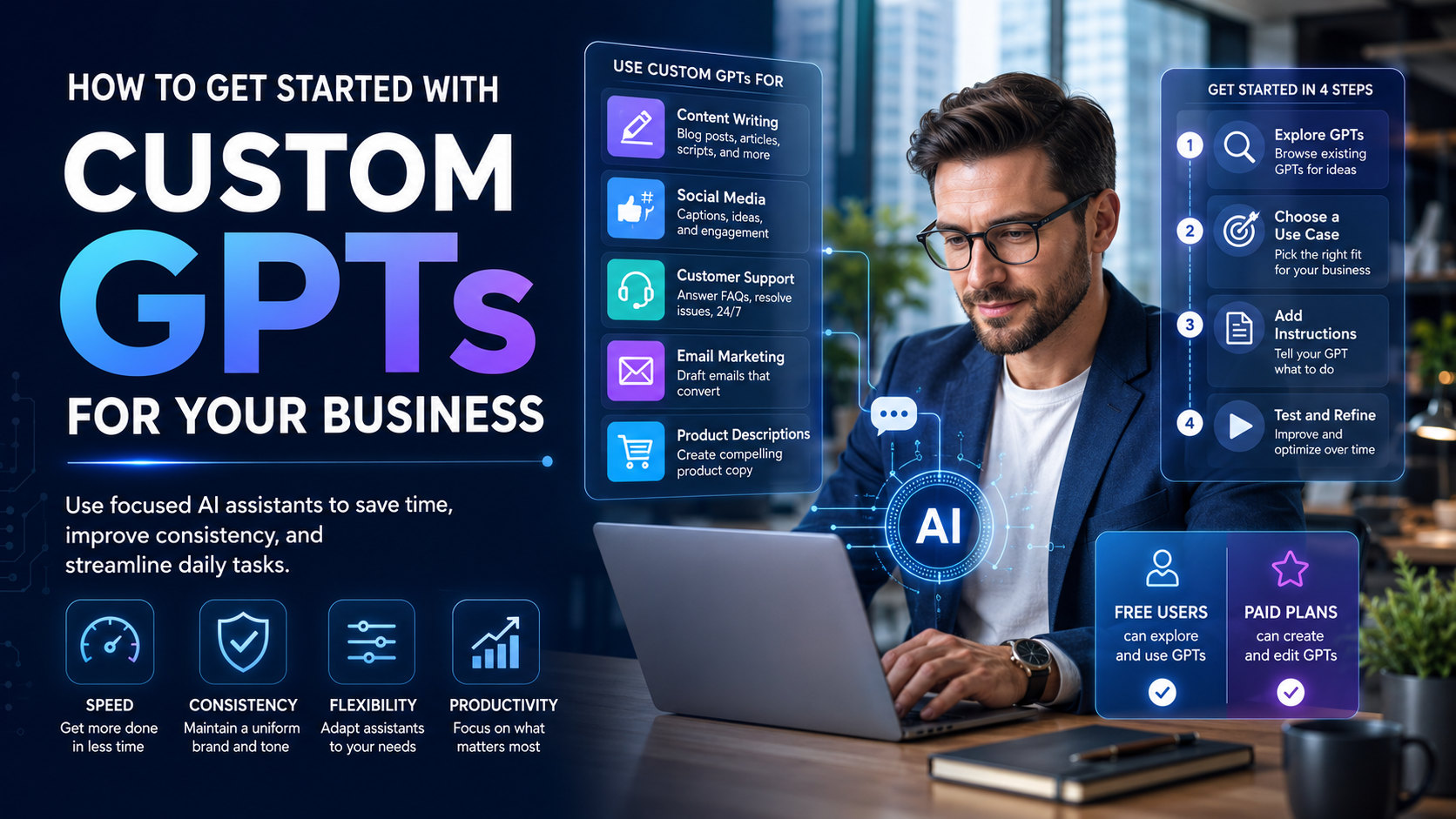
Artificial Intelligence is no longer just a trendy business topic. It has become a practical tool that entrepreneurs, freelancers, coaches, agencies, and small business owners are using every day to save time, improve communication, create better content, and simplify routine work. One of the most powerful ways to use ChatGPT is through custom GPTs, which are specialized AI assistants designed for specific tasks, workflows, or business needs.
Instead of using one general AI chat for everything, custom GPTs allow you to work with an assistant that has a clearer purpose. You can use a GPT for writing blog posts, generating social media content, improving customer support, planning marketing campaigns, drafting emails, organizing ideas, or supporting your daily business operations.
If you are new to AI, the idea of custom GPTs may sound technical at first. The good news is that using GPTs is much easier than many people realize. You do not need to be a programmer or developer to benefit from them. You simply need to understand what they are, how they work, and how they can support your business goals. The original article focused on introducing custom GPTs, how they help businesses, and how entrepreneurs can begin using them for practical tasks.
What Are Custom GPTs?
Custom GPTs are specialized versions of ChatGPT that are designed to follow specific instructions, perform certain tasks, and support particular goals. Think of them as focused AI assistants. They are still powered by ChatGPT, but they can be configured with instructions, knowledge, tools, and behaviors that make them more useful for a specific purpose.
For example, instead of asking a general AI assistant to help with everything, you might use a content writing GPT that focuses on blog posts, article outlines, and SEO-friendly content. You might use a social media GPT that helps create captions, hashtags, content calendars, and promotional post ideas. You might use a customer support GPT that helps draft polite, consistent responses to common customer questions.
This is what makes custom GPTs so valuable. They help reduce the need to repeat the same instructions every time. If a GPT is set up for a specific business function, it can deliver more consistent results because it already understands its role.
OpenAI describes GPTs as assistants that can include instructions, conversation starters, uploaded knowledge, capabilities such as selected tools, and other configuration elements that shape how the GPT behaves.
Why Custom GPTs Matter for Online Businesses
Online business owners often wear many hats. You may be the marketer, writer, customer service representative, product creator, strategist, and operations manager all at once. That can become overwhelming, especially when the same tasks keep showing up week after week.
Custom GPTs can help by turning repeatable tasks into faster workflows. Instead of starting from scratch every time you need a blog post, email sequence, product description, or customer response, you can use a GPT that is already focused on that type of work.
This can save time, reduce mental fatigue, and help you stay consistent. For a small business owner, consistency is often one of the biggest challenges. You may have great ideas, but not enough time to turn those ideas into polished content, marketing messages, and customer communication. A well-designed GPT can help close that gap.
Can Free Users Use Custom GPTs?
Free users can discover and use GPTs in ChatGPT, but there is an important distinction. According to OpenAI’s current help documentation, GPTs are available to ChatGPT users who are signed in, and Free users can discover and use GPTs in the GPT store. However, creating or editing GPTs currently requires a paid subscription.
That means a Free user can still benefit from GPTs by browsing available GPTs and using ones that are public or shared with them. But if you want to build your own custom GPT from scratch, configure its instructions, add knowledge, edit its behavior, or create a specialized assistant for your business, you would need access through a paid plan that includes GPT creation.
This is still good news for beginners. You can start by exploring existing GPTs, learning how they work, and seeing which types of AI assistants are useful for your business. Then, when you are ready to create your own, you will have a much clearer idea of what you want your GPT to do.
How to Explore GPTs in ChatGPT
Inside ChatGPT, users can access available GPTs through the GPTs area or Explore GPTs section. This works like a directory where you can browse different AI assistants created for specific needs. You may find GPTs for writing, business planning, productivity, learning, design, research, marketing, coding, coaching, and more.
This is a helpful starting point because it lets you see what is possible before building your own. You can test different GPTs, compare the quality of their responses, and think about which tasks in your business could benefit from a more specialized assistant.
For example, an entrepreneur might explore GPTs for content planning, SEO writing, lead magnet creation, email marketing, or customer communication. A coach might look for GPTs that help with lesson planning, client worksheets, social media content, or workshop outlines. A freelancer might use GPTs for proposals, project briefs, client emails, or portfolio copy.
The more you explore, the easier it becomes to recognize where AI can save time in your business.
How Custom GPTs Are Created
Creating a GPT does not require coding, but it does require clarity. When someone creates a GPT, they define what the GPT should do, how it should respond, what tone it should use, and what type of information it should rely on.
The creator may add instructions such as: “Write in a professional but friendly tone,” “Create SEO-friendly blog posts,” “Ask clarifying questions before drafting,” or “Use short paragraphs and clear calls-to-action.” The creator may also upload knowledge files or provide business-specific information that helps the GPT produce more relevant responses.
OpenAI’s GPT creation documentation explains that GPTs can be created and configured by opening the GPTs area, selecting Create, configuring the GPT through a builder or editor, testing it in preview, and saving the finished version.
The most important part of creating a useful GPT is not technical skill. It is knowing what job you want the GPT to perform. A vague GPT will usually produce vague results. A focused GPT with clear instructions will usually perform much better.
Examples of Custom GPTs for Business
A custom GPT can be created for almost any repeatable business task. For example, a blog writing GPT can help generate article ideas, outlines, introductions, full drafts, meta descriptions, and FAQ sections. A social media GPT can help create captions, hooks, post calendars, reels ideas, carousel outlines, and promotional content.
A customer support GPT can help draft polite responses to common questions about orders, downloads, refunds, appointments, services, or account access. A product description GPT can help create clear, persuasive descriptions for digital products, physical products, courses, books, templates, or services.
A marketing campaign GPT can help plan promotions, write ad copy, create email campaigns, and develop launch strategies. A productivity GPT can help organize tasks, summarize notes, create checklists, and build weekly action plans.
The best GPTs are not random. They are built around a specific purpose.
Benefits of Using Custom GPTs in Business
The first major benefit of custom GPTs is speed. Tasks that normally take hours can often be drafted in minutes. This does not mean you should publish everything exactly as AI creates it, but it does mean you can move from blank page to usable draft much faster.
The second benefit is consistency. When a GPT is designed around a particular tone, structure, or workflow, it can help your content feel more aligned. This is especially important for business owners who want their emails, blog posts, product pages, and social media content to sound like they belong to the same brand.
The third benefit is flexibility. You can use different GPTs for different parts of your business. One GPT might help with SEO content. Another might help with customer support. Another might help with product planning. Another might help with marketing campaigns.
The fourth benefit is productivity. Custom GPTs help reduce repetitive work so you can spend more time on strategy, customers, sales, partnerships, product creation, and business growth.
Common Mistakes to Avoid
One common mistake is expecting a GPT to do everything perfectly without clear instructions. AI performs better when the goal is specific. Instead of saying, “Help me with my business,” it is better to say, “Create a 700-word blog post for beginner online business owners about using AI to save time, written in a friendly and practical tone.”
Another mistake is relying on AI without reviewing the output. Custom GPTs are powerful, but they still need human judgment. You should review important content before publishing, especially when it involves business claims, legal language, financial information, health information, customer policies, or brand-sensitive messaging.
A third mistake is putting sensitive information into AI tools without thinking carefully. It is wise to avoid entering passwords, private customer data, confidential financial information, or personal identification details into any AI system unless you fully understand the privacy and security implications.
A fourth mistake is creating too many GPTs without a clear workflow. It is better to start with one or two useful GPTs than to create a large collection you never use.
Safety and Best Practices
Custom GPTs work best when they are treated as assistants, not replacements for your business judgment. Use them for drafting, organizing, brainstorming, outlining, summarizing, and improving your workflow. Then review and refine the final output yourself.
It is also smart to create clear usage rules. For example, you might decide that AI can draft customer responses, but you personally review them before sending. Or AI can write product descriptions, but you check every detail for accuracy. Or AI can create blog drafts, but you add your own experience, examples, and final edits before publishing.
This approach helps you get the time-saving benefits of AI while still protecting your brand quality.
What Results Can You Expect?
When custom GPTs are used properly, businesses can see meaningful improvements in speed, consistency, and organization. Marketing content can be produced faster. Customer responses can become more polished. Blog ideas can be generated more easily. Social media planning can become less stressful. Product descriptions and email drafts can be created with less effort.
Even if you start by using public GPTs instead of creating your own, you can still begin improving your workflow. Over time, as you learn which tasks you repeat most often, you may decide to invest in creating or purchasing specialized GPTs that are better matched to your business.
The best results come when GPTs are used as part of a system. A GPT should not just be something you test once and forget. It should become part of how you create, communicate, plan, and operate.
Our Store of Custom GPTs
At The Action Challenge Hub, our store offers custom GPTs and AI-powered resources designed to help business owners, entrepreneurs, freelancers, coaches, creators, and agencies save time and get better results.
Instead of trying to build every GPT from scratch, you can explore tools that are already designed for practical business needs. These may include GPTs for SEO blog writing, social media content, customer support, product descriptions, email marketing, business planning, digital product creation, and more.
The goal is simple: help you skip some of the trial and error so you can start using AI in a more focused and productive way.
Whether you are just beginning with AI or looking to build a stronger workflow, custom GPTs and prompt-based tools can help you move faster and work smarter.
Final Thoughts
Custom GPTs are one of the most useful ways to make AI more practical for your business. Instead of using AI only as a general chatbot, you can use specialized assistants that support specific tasks, goals, and workflows.
Free users can still explore and use GPTs, which makes it easy to begin learning how they work. If you want to create or edit your own GPT, current OpenAI documentation says that requires a paid subscription.
The best way to get started is simple. Explore the GPTs that are already available. Test a few that match your business needs. Pay attention to where they save you time. Then decide whether you need a custom-built GPT, a prompt pack, or a ready-made business GPT from a trusted source.
AI becomes more powerful when it is focused. When you use the right GPT for the right task, you can create faster, communicate better, serve customers more consistently, and give yourself more time to focus on growth.













0 Comments