
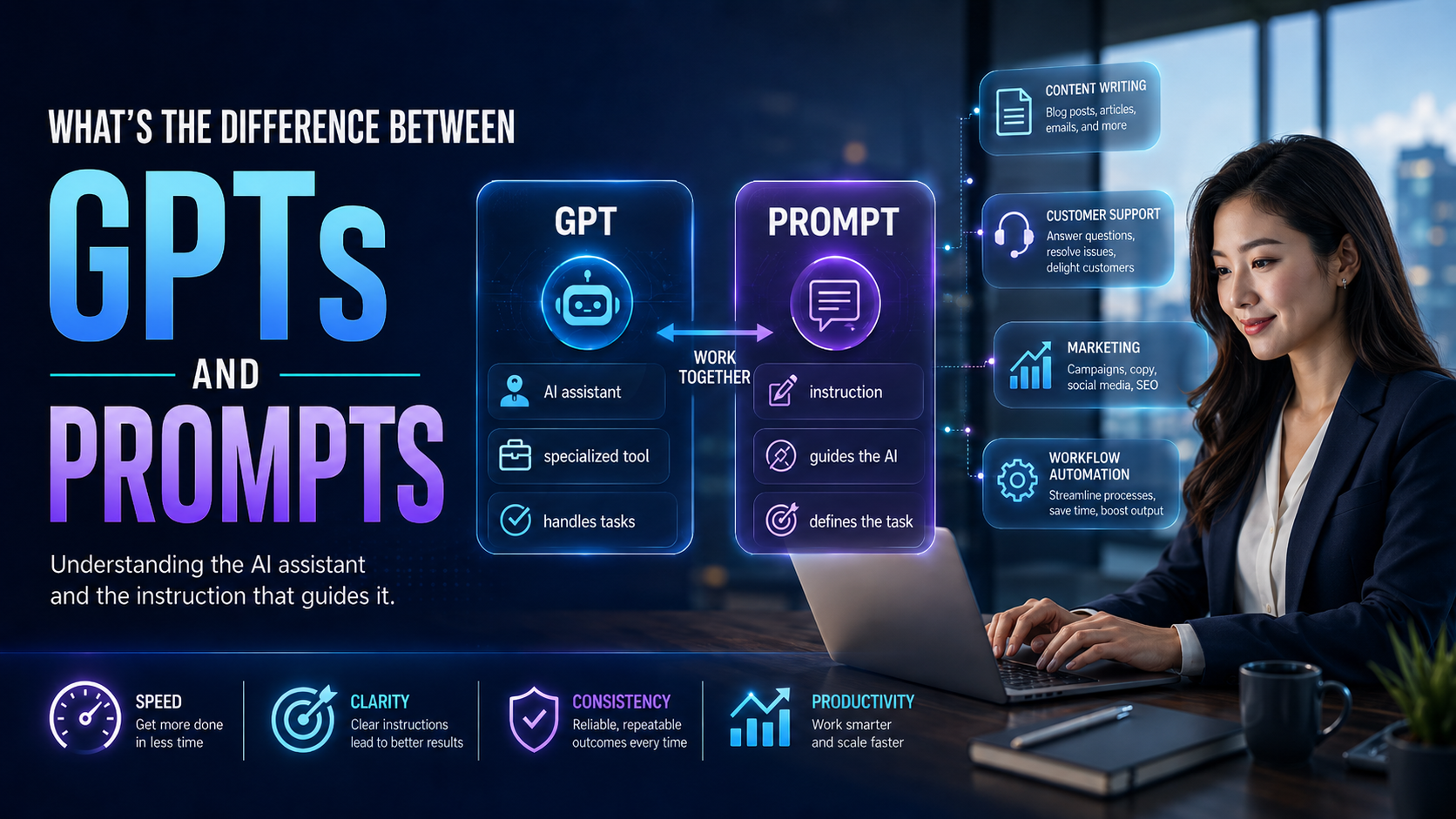
Artificial Intelligence has quickly become a practical business tool. Entrepreneurs, freelancers, coaches, agencies, and small business owners now use AI to write content, answer customer questions, brainstorm ideas, create marketing campaigns, improve productivity, and save time on routine tasks. But as more people begin using AI, two terms often create confusion: GPTs and prompts.
Many people use these words as if they mean the same thing, but they are different. Understanding the difference can help you get better results from AI, choose the right tools for your business, and avoid wasting time with unclear instructions or the wrong setup.
The simple way to understand it is this: a GPT is the AI system or specialized assistant, while a prompt is the instruction you give it. One is the tool. The other is the direction. When they work together properly, they can help you create faster, communicate better, and run your business more efficiently. The original article explained this core relationship between GPTs and prompts, including how each one supports business productivity and content creation.
What Is a GPT?
A GPT is an artificial intelligence model designed to understand language and generate human-like responses. The term GPT stands for Generative Pre-trained Transformer. In simple terms, it is the technology that allows AI tools to read your request, understand patterns in language, and produce a response that feels natural and useful.
When people talk about GPTs inside ChatGPT, they may also be referring to custom GPTs. A custom GPT is a specialized version of ChatGPT that is designed for a particular purpose. Instead of using a general AI assistant for every task, a business owner can use a GPT that is focused on one specific job.
For example, an online store might use a GPT that helps write product descriptions. A coach might use a GPT that creates client worksheets and follow-up emails. A real estate agent might use a GPT that drafts property listings. A blogger might use a GPT that creates SEO-friendly article outlines. A customer service team might use a GPT that helps draft polite responses to common questions.
This makes GPTs similar to specialized assistants. They can help with many types of work, but when they are designed for a specific role, they can deliver more focused and consistent results.
What Is a Prompt?
A prompt is the instruction you give to the AI. It tells the GPT what you want it to do.
A prompt can be short and simple, such as:
Write a thank-you email to a new customer.
A prompt can also be detailed and specific, such as:
Write a friendly 300-word thank-you email for a new customer who just purchased a digital marketing guide. Use a warm and professional tone, remind them how to access their download, and end with an invitation to explore related resources in our store.
Both examples are prompts, but the second one gives the AI much more direction. It explains the audience, the purpose, the tone, the product type, and the desired ending. Because of that, the result will usually be stronger and more useful.
Prompts matter because AI needs clear instructions. If your prompt is vague, the answer may be vague. If your prompt is specific, the answer is more likely to match what you actually need.
In business, strong prompts can help you get better blog posts, emails, social media captions, product descriptions, customer replies, sales copy, and brainstorming ideas.
The Simple Difference Between GPTs and Prompts
The easiest way to understand the difference is to think of the GPT as the assistant and the prompt as the assignment.
The GPT is the system that does the work. The prompt is the instruction that tells it what work to do.
A custom GPT may already be trained or configured to understand a certain type of task. For example, a social media GPT may already know that its job is to create captions, hashtags, post ideas, and content calendars. But it still needs a prompt to know what you want in that specific moment.
For example, you might tell a social media GPT:
Create five LinkedIn posts for a business consultant who helps small business owners improve productivity. Use a confident, encouraging tone and include a short call-to-action at the end of each post.
The GPT provides the capability. The prompt provides the direction.
That is why GPTs and prompts work best together.
How GPTs and Prompts Work Together
A GPT without a prompt does nothing. A prompt without a GPT has nowhere to go. The two work together.
Even a powerful GPT needs clear instructions to produce the best response. At the same time, a strong prompt can make a general GPT perform much better. This is why prompt writing is such an important skill.
For business owners, this creates two smart paths.
First, you can use well-written prompts to get better results from the AI tools you already have. This is helpful if you are just getting started or if you want quick improvements without building anything custom.
Second, you can use custom GPTs for repeatable tasks that happen often in your business. This is helpful when you want a more consistent workflow for content creation, customer support, marketing, product descriptions, or planning.
Many businesses eventually use both. They use custom GPTs for specialized work and prompt packs for flexible tasks.
Why GPTs Are Useful in Business
GPTs are useful because they help turn repetitive work into faster workflows. Instead of starting from scratch every time, you can use a GPT to help generate a first draft, organize ideas, improve wording, or create structured content.
A business might use GPTs to write blog posts, draft email campaigns, create social media calendars, answer customer questions, summarize notes, generate product descriptions, or plan promotions.
The major benefit is speed. A task that might take hours can often be drafted in minutes. That does not mean the output should always be used without review. It means you can move faster from idea to draft, then use your judgment to refine the final result.
Another benefit is consistency. When a GPT is designed for a specific purpose, it can help keep your tone, structure, and messaging more uniform. This matters when your business needs to sound professional across your website, emails, product pages, and social media content.
GPTs can also reduce mental fatigue. Many business owners waste time staring at a blank page. A GPT gives you a starting point so you can spend more time improving the message instead of struggling to begin.
Why Strong Prompts Are Important
Prompts are powerful because they shape the quality of the AI response. The same GPT can produce a weak answer or a strong answer depending on the prompt.
A weak prompt might say:
Write something about marketing.
That instruction is too broad. The AI does not know the audience, purpose, tone, length, format, or goal.
A stronger prompt would say:
Write a 700-word blog post for small business owners about how email marketing helps build customer relationships. Use a helpful and encouraging tone, include practical examples, and end with a call-to-action to download a free marketing checklist.
That prompt gives the GPT a clear job. It explains who the content is for, what the content should be about, how long it should be, how it should sound, and what action the reader should take.
Strong prompts help you get better results with less editing. They also help your team stay consistent if multiple people are using AI in the business.
Custom GPTs vs. Prompt Packs
A custom GPT and a prompt pack are different, but they can work together.
A custom GPT is like a focused assistant that has been set up for a specific purpose. A prompt pack is a collection of ready-made instructions you can use with an AI tool.
For example, you might have a custom GPT that specializes in writing blog posts for your business. You might also have a prompt pack that includes instructions for writing headlines, introductions, meta descriptions, social media captions, and email summaries.
The GPT gives you a specialized workspace. The prompt pack gives you proven instructions.
If you are new to AI, prompt packs are often a simple way to start because you can copy, paste, and customize instructions right away. If you use AI often for the same tasks, a custom GPT may save more time because it can be designed around your workflow.
The best option depends on your business needs.
Common Mistakes People Make with GPTs and Prompts
One common mistake is thinking AI can read your mind. It cannot. If you do not explain what you want, the AI has to guess. That usually leads to generic results.
Another mistake is using prompts that are too short for complex tasks. A short prompt may be fine for a simple request, but if you want a complete blog post, a sales page, a product description, or a customer email, you need to provide more detail.
A third mistake is expecting a custom GPT to fix unclear strategy. A GPT can help you create content, but it still needs a clear business goal. If you are not sure who your audience is, what offer you are promoting, or what result you want, the GPT may produce content that sounds polished but does not move your business forward.
Another mistake is relying on AI without reviewing the final result. AI can be extremely helpful, but human judgment still matters. You should always check for accuracy, tone, brand fit, and clarity before publishing or sending anything important.
Safety and Reliability
AI can help businesses move faster, but it should be used wisely. Avoid putting sensitive information into prompts, such as passwords, private customer records, confidential financial details, or personal identification information.
It is also important to review AI-generated content for accuracy. GPTs can sometimes produce information that sounds confident but may not be correct. This is especially important in industries such as healthcare, finance, legal services, insurance, and compliance-sensitive fields.
The safest approach is to use AI for drafting, brainstorming, organizing, and improving content. Then review and refine the output before using it publicly.
AI is a powerful assistant, but it should not replace professional judgment.
What Results Can Businesses Expect?
When GPTs and prompts are used correctly, businesses can save time and improve consistency. Blog posts can be drafted faster. Social media content can be planned more easily. Customer responses can become more polished. Product descriptions can be written more efficiently. Marketing campaigns can move from idea to execution faster.
The real benefit is not just speed. The real benefit is workflow improvement.
Instead of repeating the same writing and planning tasks every week, you can create a system. GPTs handle specialized work. Prompts give clear direction. Together, they help your business operate more smoothly.
This can lead to better content, stronger communication, improved customer experience, and more time for strategy and growth.
Which One Should You Focus on First?
If you are just getting started with AI, focus on learning how to write better prompts first. Strong prompts will improve your results immediately, even if you are using a general AI tool.
Start by being clear about five things: the task, the audience, the tone, the format, and the goal.
For example, instead of saying:
Write an email.
Say:
Write a friendly welcome email for new subscribers who downloaded a free online business checklist. Keep it under 250 words, use an encouraging tone, and invite them to explore our related resources.
Once you become comfortable with prompts, you can begin exploring custom GPTs. If you notice that you are using the same type of prompt repeatedly, that may be a sign that a custom GPT would be useful.
Final Thoughts
The difference between GPTs and prompts is simple, but important. A GPT is the AI system or specialized assistant that creates the response. A prompt is the instruction that tells the GPT what to do.
You need both.
A strong GPT can help you work faster. A strong prompt can help you get better results. When you combine the two, AI becomes far more useful for your business.
If you are new to AI, start with prompts. Learn how to give clear, specific instructions. As your needs grow, consider using custom GPTs for repeatable tasks such as blog writing, social media planning, customer support, product descriptions, and marketing campaigns.
AI is not here to replace your business. It is here to help you run it more efficiently. When you understand how GPTs and prompts work together, you can save time, improve communication, and build a smarter workflow for growth.















0 Comments